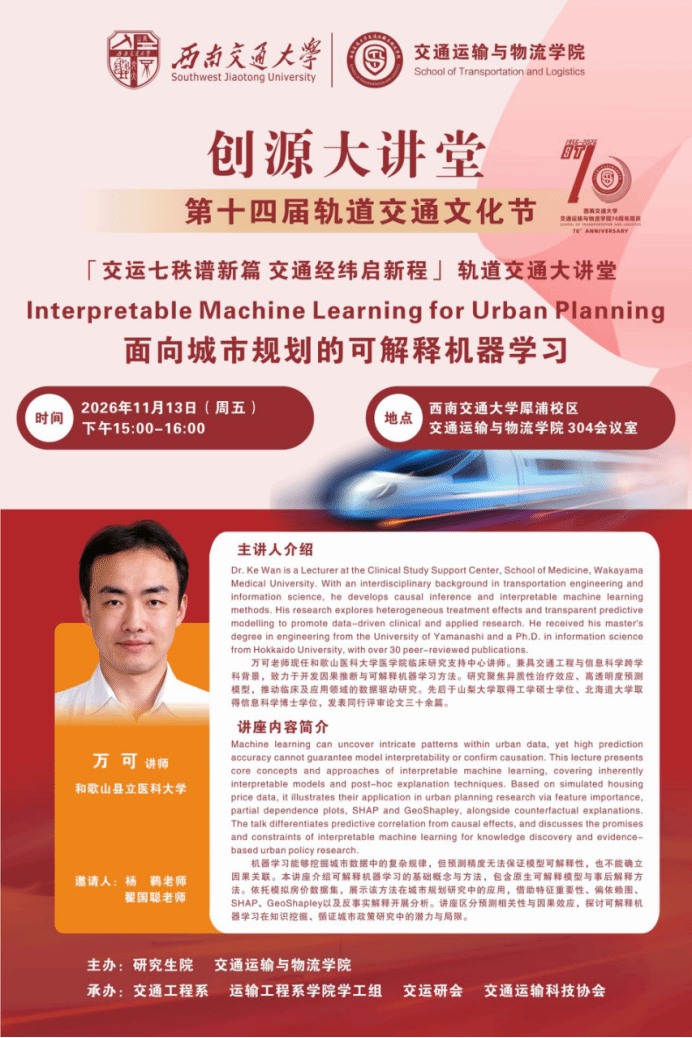
1.【讲座名称】
Interpretable Machine Learning for Urban Planning
面向城市规划的可解释机器学习
2.【主讲人】
万可,和歌山县立医科大学
3.【主讲人介绍】
Dr. Ke Wan is a Lecturer at the Clinical Study Support Center, School of Medicine, Wakayama Medical University. With an interdisciplinary background in transportation engineering and information science, he develops causal inference and interpretable machine learning methods. His research explores heterogeneous treatment effects and transparent predictive modelling to promote data-driven clinical and applied research. He received his master’s degree in engineering from the University of Yamanashi and a Ph.D. in information science from Hokkaido University, with over 30 peer-reviewed publications.
万可老师现任和歌山医科大学医学院临床研究支持中心讲师。兼具交通工程与信息科学跨学科背景,致力于开发因果推断与可解释机器学习方法。研究聚焦异质性治疗效应、高透明度预测模型,推动临床及应用领域的数据驱动研究。先后于山梨大学取得工学硕士学位、北海道大学取得信息科学博士学位,发表同行评审论文三十余篇。
4.【讲座内容简介】
Machine learning can uncover intricate patterns within urban data, yet high prediction accuracy cannot guarantee model interpretability or confirm causation. This lecture presents core concepts and approaches of interpretable machine learning, covering inherently interpretable models and post-hoc explanation techniques. Based on simulated housing price data, it illustrates their application in urban planning research via feature importance, partial dependence plots, SHAP and GeoShapley, alongside counterfactual explanations. The talk differentiates predictive correlation from causal effects, and discusses the promises and constraints of interpretable machine learning for knowledge discovery and evidence-based urban policy research.
机器学习能够挖掘城市数据中的复杂规律,但预测精度无法保证模型可解释性,也不能确立因果关联。本讲座介绍可解释机器学习的基础概念与方法,包含原生可解释模型与事后解释方法。依托模拟房价数据集,展示该方法在城市规划研究中的应用,借助特征重要性、偏依赖图、SHAP、GeoShapley以及反事实解释开展分析。讲座区分预测相关性与因果效应,探讨可解释机器学习在知识挖掘、循证城市政策研究中的潜力与局限。
5.【时间】
2026年11月13日(周五)15:00-16:00
6.【地点】
西南交通大学犀浦校区11号教学楼交运大楼304会议室
 图片新闻

版权所有 © 西南交通大学交通运输与物流学院
地址:四川省成都市郫都区犀安路999号 邮编:611756 联系电话:(028)66366165 学院其他部门联系电话
 学院办公室:
 学院纪委邮箱:
 投稿咨询:


版权所有 © 西南交通大学交通运输与物流学院
地址:四川省成都市郫都区犀安路999号 邮编:611756 联系电话:(028)66366165 学院其他部门联系电话
学院办公室:
学院纪委邮箱:
投稿咨询:


 English
 下载专区
 公告搜索




 最近更新
